The Entitlement Trap
Entitlement: The thing that can rips families & communities apart

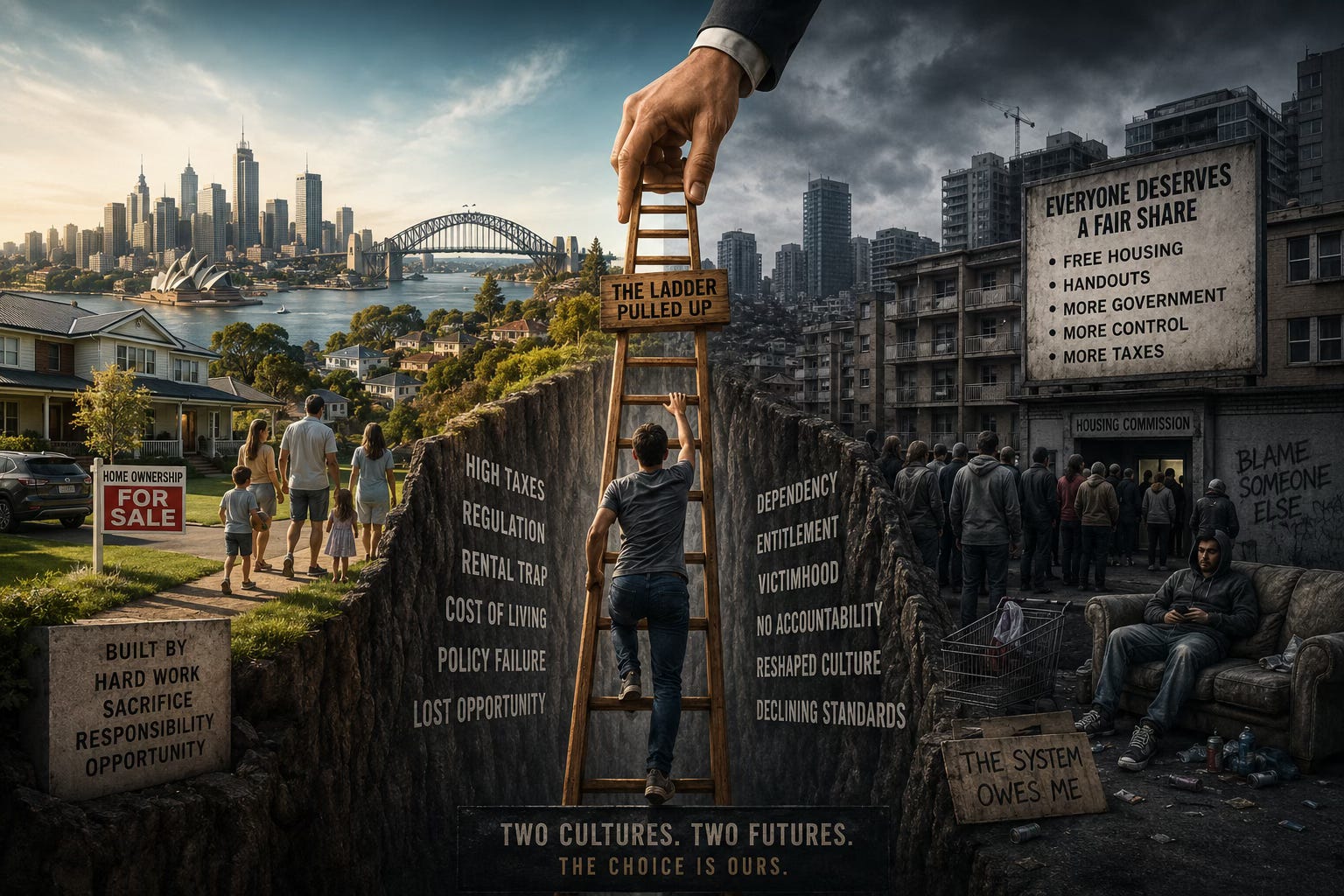
Entitlement now sits quietly underneath almost everything, the expectation that everyone is owed their fair share, their outcome, their version of fairness. But I’ve been returning to the word not as a casual accusation, but as something closer to a diagnosis. A way of making sense of a society that has drifted a long way from where it began.
How did we move, in just three generations, from a society built around survival, aspiration, and genuine progress into one so consumed by conflict, grievance, and competing claims about who deserves what? And at what point did we start normalising the punishment of the very things that allowed us to prosper in the first place?
These are not rhetorical questions. They are the ones I find myself unable to stop asking.
My own personal story starts in Sydney, close to where I live now, though I’m at an age where I’ve stopped volunteering exactly how long ago that was. I went to school in Central Queensland, after my family moved there during those years. Yes, you can keep the jokes, my Sydney family certainly did, growing up, and honestly still do. Being paid out for growing up in Queensland by people who had barely left the northern beaches turned out to be its own education. It told you everything about the limits of a certain Sydney worldview.
When I left many years ago, my home suburb sat in blue ribbon Liberal heartland, the centre of what conservatism used to mean before the word got hollowed out. I know what it looks like when family members marry young and stay married to the same person for forty or over sixty years. That was the conservatism that built families, provided for children, and created the conditions for the long term wealth we now spend so much energy fighting over. It wasn’t perfect. But it was stable, and stability turned out to matter far more than anyone admitted at the time.
Central Queensland was the opposite. Labor heartland, deep and unquestioned, where your vote was inherited across generations and taken for granted by the government, while the disadvantaged stayed disadvantaged and looked to government for answers that rarely came. I used to wonder, growing up, why Labor would actually want these people to succeed, to become wealthy, move up, move on, if doing so meant they might stop voting Labor. It was a random thought for a young person to have. But watching it play out over decades, I’m not sure the instinct was wrong.
The clearest example is housing. Labor governments, state and federal, have presided over the most sustained destruction of working class wealth in Australian history not through malice necessarily, but through a consistent preference for policies that keep people renting, keep them dependent, and keep them looking to government for relief rather than building anything of their own. A person who owns their home is harder to frighten at election time. A person paying record rent is not.
Growing up across both cultures gave me something I didn’t appreciate at the time, an ability to read the difference between the two political tribes from the inside. Not just what each side said, but how each side lived, and what each side quietly believed it was owed. That perspective is the lens through which everything that follows is written.
Which raises a question I don’t hear asked nearly enough, has anyone stopped to think about what progress has actually delivered?
More cars and more people on streets built for far fewer. A government with a limitless appetite for influencing every corner of your life without any accountability over the outcomes it produces. Fewer children, because maybe it is harder to find partners willing to commit to more than a shared lease, and harder to raise them once you do. And more entitlement, a creeping suffocation of ambition that has kept an entire generation dependent on either the government or the one before it, stuck in a small box and calling it a life.
If that is progress, it is an unusually convincing imitation of regression.
Some of my earliest memories in Sydney exposed me to the assumption based all around me that life would work out regardless of whether you chose to work for it. I was lucky enough to live in an apartment block my family mostly owned, back when local families could do that freely and without much fuss.
Driving through the area recently with my almost ninety four year old great uncle, it was clear just how much has changed and how many properties along that stretch he had owned during his life. All of it built not through government assistance, but by a generation given the opportunity to invest without capital gains tax, at a time when mass immigration and foreign capital had not yet reshaped the housing market beyond recognition.
Penguins wandered into swimming pools and made the front page of the local paper. Local families owned mansions and bought their kids near by acreage for their horses. I watched family members look at what they would one day inherit and say, without embarrassment, that they would never have to work again.
You don’t forget entitlement once you’ve seen it wearing a familiar face.
And mostly, they were right. Some didn’t even raise the children they had, the responsibility felt too large, and their helicopter parents had never encouraged otherwise. Those children were quietly handed back to grandparents or parents to be raised instead. Others never held a stable job or any job at all, had multiple homes bought for them which they promptly trashed, and eventually became addicts, lying and stealing to survive.
The end point of entitlement is not arrogance. It is something much sadder than that. Some of them are missing teeth now from the drug abuse that followed. Wealth without purpose. Inheritance without obligation. What one generation thought was help turned out to be the very thing that held the next generation back from real life.
My grandfather built his world from a harbour front home with its own boat ramp, a position I’ve since learned was made possible partly through his brother, who lived around the corner in his own mansion and who had recently sold a block of nearby apartments, leaving him in a position to help provide the financial foundation. He went on to invest in businesses across the country, including the first one my father established after the family moved to Queensland, which later expanded to include an operation at the Gladstone Port.
That opportunity came with an expectation, my grandfather encouraged my father to learn a trade and made it clear he was not to simply live off the family name. He pointed him toward something real, something practical, something he could build with his own hands and my father went and did it.
My grandfather understood that timing, family, and circumstance all played a part in his own success. He also understood that the role of government was to create conditions for people to build things, not to insert itself into every corner of their lives. A principle we are watching disappear in real time.
Which is perhaps why I’ve always found it curious that the people in my family who attended some of the most expensive Sydney schools ended up, in many cases, with the least and in the worst circumstances. Always wanting more handed to them. Wanting businesses given rather than built. What exactly did we pay for? The answer, I suspect, is that we paid to insulate certain people from the very experiences that build character and gave us the principles to succeed. The bill came due much later. It always does.
Central Queensland was something else entirely. I went to school with First Nations kids, not as symbols or statistics, but as classmates. A coal fired power station wasn’t a political talking point; it was part of everyday life. It provided jobs, affordable power, and helped the country capitalise on one of the largest mining booms it had ever seen.
Real financial hardship sat alongside gambling, making do, and people having children regardless of whether the circumstances were ideal all thinking it was normal.
There was a toughness to central Queensland, but there was also a ceiling. Ambition could be met with scepticism rather than encouragement. If you talked about wanting something different, someone would quickly tell you it probably wouldn’t happen, not out of cruelty, but out of a worldview that had never been shown otherwise.
I remember Friday nights during my first degree in Brisbane, debating politics over wine with my closest friend at the time an intergenerational Labor voter who came by her views honestly. She was warm, sharp, and genuinely good company. But she struggled to imagine that a life could be more than a steady job and a decent holiday.
That a relationship could also be a partnership in the truest sense, two people building something from nothing together. It wasn’t a failure of intelligence. It was a failure of imagination, and the imagination had been shaped by what she had been shown was possible.
That is a pattern I noticed in some communities where stability and support were strongly emphasised, and where examples of building beyond a certain point were less visible or less frequently reinforced. It wasn’t that people were told they couldn’t succeed, but that the reference points for what “success” looked like were often closer to steady employment and security than accumulation or upward mobility. Over time, that can quietly shape what people assume is realistic.
The current Labor government has arguably formalised some of these pressures through its policy direction. The 2026 Budget continued a broader shift toward tightening tax concessions, including changes affecting superannuation tax treatment for higher balances, alongside proposed and debated measures targeting investment incentives such as negative gearing and capital gains tax settings.
While some reforms remain subject to consultation and future legislation, the overall direction signals a reduced generosity in tax settings for investment income and wealth accumulation.
That tension sits at the heart of this entire discussion. Do we want a society where more people are encouraged to own, build, invest, and create or one where opportunity becomes increasingly dependent on existing family wealth, government decisions, and access to the right systems?
Redistribution is easier to explain than aspiration. Fairness is easier to promise than opportunity. And a person who has never been shown what building something looks like can eventually start believing that the ceiling is permanent.
But here is what I’ve learned to hold onto.
That same friend and her partner went on to start an online business together. They have since won awards for it. The ceiling wasn’t permanent. It just needed someone to point at it and say, that isn’t actually the roof. At the time, I couldn’t understand why. It took me years to realise that sometimes people dismiss another person’s ambition not because it is impossible, but because it forces them to confront the possibilities they didn’t pursue themselves.
Housing commission homes in places filled the streets in some suburbs. Coming from where I came from, I’ll be honest, I never quite felt at home there.
But that discomfort taught me something I couldn’t have learned in Sydney. It showed me what a political culture built on permanent grievance looks like at street level, a society so dependent on government it had forgotten how to stand on its own. Entitlement isn’t just a personality flaw. It can become the operating system of an entire community.
When it does, aspiration quietly dies. And the people who suffer most are not those at the top, but those at the bottom, those who are repeatedly told that their circumstances are someone else’s fault, and that the solution is always another government program, another tax on someone else, another redistribution of someone else’s effort.
What struck me most, looking back, is that many of the friends I felt sorry for then, kids who grew up in unfavourable circumstances with genuinely hard lives, who had far less than me in every material sense, have since built serious businesses that employ people. They didn’t wait for the system to save them. They built their way out. And these are now the very people that Labor heartland politics seeks to pull down to tax more, regulate more, discourage in the name of ensuring no one rises too far above anyone else. Equality of outcome, dressed as fairness. Entitlement, dressed as justice all in the name of more voters for the next election.
Looking back at where I am now I remember how where I am in Sydney was once a community of prosperous families and affordable homes but has since given way to something shinier, more crowded, and somehow much emptier.
The ethos that backed private enterprise and rewarded people who had a go is largely gone. In its place is a community that encouraged immigration to prop up property values, priced out its own children, and now expresses bewilderment at why those children won’t leave home. The ownership society gave way to the rental society. And the people who benefited most from the old order pulled the ladder up behind them, whether they meant to or not.
Then there is the question nobody wants to ask plainly, so I will.
It appears most people feel Immigration has not been managed well over the past two decades. The major parties know it, you can hear it in what they say privately even when they won’t say it publicly, and the gap between that private acknowledgement and public honesty has never been wider.
I understand why high immigration is attractive to different groups. For employers, it increases labour supply. For property owners, it can increase demand for housing. But the effects are unevenly distributed. In some parts of the economy, particularly housing, pressure on prices can make entry harder for people relying on domestic wages and borrowing conditions.
In a global capital environment, people arriving with significant offshore wealth, built under different tax and regulatory settings, can compete directly in Australian housing and investment markets. That can make it harder for locals, particularly those relying on wages and borrowing capacity, to get started in those markets.
And the argument that immigration is now under control because the numbers have eased slightly misses the point entirely. The playing field itself is just about to change. With the government’s proposed tax increases still to flow through, the more important question becomes, who will actually want to come to Australia, and what will new arrivals contribute if they arrive without capital, into an economy carrying record national debt, with a tax environment increasingly hostile to anyone trying to build something?
Controlling the volume of migration means very little if the quality of the conditions we are offering and imposing continues to deteriorate.
There is also something harder to say. This week in the United Kingdom, an eighteen year old was stabbed five times. When police arrived, his killer claimed to be the victim of a racial attack. Officers took him at his word, handcuffed him as he bled out on the driveway, and he died. The killer was sentenced to life in prison. That is where the culture of silencing leads. When fear of appearing prejudiced overrides the duty to protect a dying person, something has gone badly wrong. We are not as far from that as we would like to believe. If we cannot name these things without being accused of bigotry, we have already lost something we will struggle to get back.
So what is entitlement, stripped back? It is the belief that one deserves rewards independent of effort, reciprocity, or consequence. It is different from ambition, which wants to earn what it gets. The entitled person sits permanently at the top of an invisible hierarchy. The entitled society assumes the good times are owed rather than made.
The damage is always quiet and cumulative. It erodes resilience, because people who expect a frictionless life are not equipped for the friction that always eventually arrives. It prevents growth, because the entitled person blames everyone else for their failures and therefore learns nothing. It destroys relationships, because nothing built on grievance rather than reciprocity lasts.
And in public life the damage is worse as once groups decide their interests are more legitimate than everyone else’s, the shared ground democracy depends on starts to disappear. Facts become negotiable. Standards bend. Integrity finds its way quietly out the door.
We traded aspiration for grievance, accountability for victimhood, and community for competition. And then expressed genuine surprise when the place became harder, colder, and less worth living in.
I don’t have a neat solution. We cannot go back to what existed before, and pretending otherwise is its own form of entitlement. I spent my younger years jealous that I couldn’t grow up in Sydney, going to school here. Until now. The people in my family who did are, in several cases, still live at home as adults, still waiting for the life they were promised. Being sent away felt like a punishment at the time. Looking back, it was the opposite.
An ageing population with fewer young people to support it. A generation with less opportunity, more dependency, and a growing sense that the system owes them something it can no longer afford to pay. A society becoming more diverse more quickly than it is becoming more united. These trends do not cancel each other out. They accelerate each other.
Nobody wants to say that plainly. So I will.
Because until we are honest about the culture we have built, and the values we quietly abandoned along the way, there is only one direction available to us.
And we have already started travelling it.
ICYMI, the same cultural dynamic is happening here in the US as well. Non-educated people dependent on gov't handouts are easier to control and manipulate.
There is much in this article that resonates with me, particularly the observation that timing increasingly matters more than effort.
A generation ago, a young couple with ordinary jobs could reasonably expect to buy a home, raise a family and build a modest level of security. Today many young people work just as hard, stay in education longer and carry greater debt, yet find themselves permanently locked out of ownership.
But I am less convinced that entitlement is the primary problem.
Most young people I meet are not demanding a life of luxury. They are asking for what their parents considered normal: somewhere affordable to live, secure employment, the possibility of raising a family and a belief that hard work will eventually be rewarded.
That is not entitlement.
That is aspiration.
The deeper problem is that we have created an economy where asset ownership increasingly determines opportunity. Those who got on the ladder early have often done very well. Those who arrived later are told to work harder on a ladder that has been pulled several feet off the ground.
In The Pitchforks Are Coming, I argue that this is where much of today’s anger comes from. Not envy of success, but the growing belief that the rules no longer work as advertised.
A healthy society should encourage ambition, enterprise and personal responsibility. But it should also ensure that the next generation has a realistic path to achieve them.
Because when people do everything right and still cannot get ahead, the problem may not be entitlement.
The problem may be the system itself.